

Filed under: Uncategorized | Leave a comment »
A “Golden” Opportunity
Posted on June 30, 2012 by clairesterling
Filed under: Uncategorized | Leave a comment »
Introducing…speed-of-light fundraising
Posted on June 13, 2012 by clairesterling
Filed under: Uncategorized | Leave a comment »
More fuel for the fire
Posted on June 13, 2012 by clairesterling
Filed under: Uncategorized | Leave a comment »
The power of good storytelling
Posted on May 30, 2012 by clairesterling
Filed under: Uncategorized | Leave a comment »
Talking (and barking and meowing) shop
Posted on May 30, 2012 by clairesterling
Filed under: Uncategorized | Leave a comment »
Are (Furry) Friends Electric?
Posted on May 30, 2012 by clairesterling
Filed under: Uncategorized | Leave a comment »
Big Things Come in Small Packages, or I Repent
Posted on May 26, 2012 by clairesterling

I confess, I was a “late adopter” of Twitter. In his New York Times article, “Why Twitter Will Endure” (Janary 1, 2010), David Carr eloquenty captured the reasons behind my initial refusal to jump into the fray of what was clearly becoming a very hot trend:
…It would be hard to come up with a noun more trite than Twitter. It impugns itself, promising something slight and inconsequential, yet another way to make hours disappear and have nothing to show for it. And just in case the noun is not sufficiently indicting, the verb, “to tweet” is even more embarrassing.
Beyond the dippy lingo, the idea that something intelligent, something worthy of mindshare, might occur in the space of 140 characters — Twitter’s parameters were set by what would fit in a text message on a phone — seems unlikely.
However, as time went on I, like Mr. Carr, began to see Twitter’s value — in serving as a helpful filter for an ever-growing barrage of information and news from around the world, in facilitating dialogues between people whose lives might not otherwise intersect, and, in the case of the uprisings in Egypt and Libya that began roughly a year after the aforementioned article was written, actually changing the political landscape rather than merely providing a platform for discussing it.
I began my Lion’s Share Twitter feed on February 5, 2011 and have tweeted 69 times to date — 16 of which have been during this month alone. It has been a wonderfully time-efficient, concise way for me to share relevant resources and ideas as soon as I discover them. In marked contrast, this is my first blog post since December — out of a grand total of 18.
Given my severe time constraints due to persistently long hours required at the office, an epic commute, and some semblance of a life outside of work, I believe that posting blog updates that mirror my tweets would be the ideal way to a) keep this blog alive and b) deliver my information to people without Twitter accounts. Tweeting is, after all, the most prevalent form of microblogging…so microblogging it shall be henceforth, at least for the time being.
I hope to roll out the occasional full-bodied article if something exceptional crops up, but in the meantime, posting primarily via Twitter will help me strike the right balance between preserving my blog and preserving what little discretionary time I can salvage. Onward and upward!
Filed under: Uncategorized | Leave a comment »
Animal philanthropy field gets an early Christmas present
Posted on December 21, 2011 by clairesterling
At the recent annual conference of Animal Grantmakers, an affinity group of U.S. foundations and organizations making grants to benefit animals, the Foundation Center unveiled its new data visualization tool developed to help Animal Grantmakers members be more strategic in their funding for animal-related issues.
Created with support from the Summerlee Foundation and incorporating data gathered and indexed by Animal Grantmakers and the Foundation Center, Philanthropy In/Sight: Animals is an innovative online interactive mapping tool that draws from two continually updated databases: one containing all grantmakers with a stated interest in animals or with grantmaking activity in this field, and the other containing all animal-specific grants awarded from 2003 to the present. In total, Philanthropy In/Sight: Animals shows data points for more than 9,600 grantmakers, more than 7,700 grant recipients, and more than 64,600 grants with a combined value of approximately $4 billion. This data reflects the full spectrum of animal species and issue areas, including: animal protection, welfare and rights perspectives; animal shelters and sanctuaries; spay/neuter clinics and other forms of animal population control; humane education, wildlife protection and injured animal rehabilitation; alternatives to factory farming; improved status for great apes; and minimization of pain and suffering to laboratory animals; among many other fields of interest.
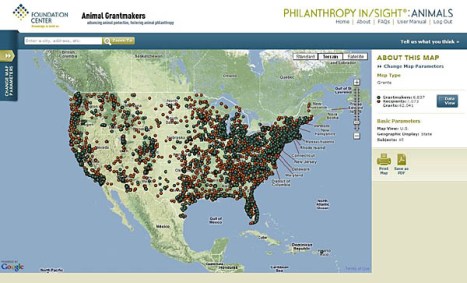
Philanthropy In/Sight: Animals enables users to create customized Google maps that pinpoint the locations of animal-focused grantmakers and grant recipients and to drill down for details about funders, recipients, and grants. The maps, which automatically reflect the latest updates from Google, display giving geographically by country, state, county, city, metro area, congressional district, or zip code. Users can overlay their maps with up to 150 demographic, socioeconomic, and other data sets to help them assess funding needs and programmatic impact, more precisely target their strategies, and map organizations within specific communities.
Philanthropy Insight: Animals has the potential to bring a tremendous new capacity to Animal Grantmakers’ constituents by enabling users to view, interpret, and visualize information in ways that quickly reveal critical relationships, patterns, and trends. It is available only to Animal Grantmakers members at this time.
Filed under: Uncategorized | Leave a comment »
Lessons Learned from Zanesville
Posted on October 23, 2011 by clairesterling
In case you haven’t heard about the shocking tragedy that unfolded in Zanesville, Ohio earlier this week, a man who owned a farm where he kept exotic pets—including lions, tigers, bears, wolves, and primates—set them all loose and then killed himself. For the sake of public safety, local authorities were forced to hunt down and kill almost all the escaped animals. Although this was alarming news, there were warning signs: the owner had not run the operation responsibly, resulting in complaints from neighbors and allegations of animal abuse and neglect; he had just spent a year in prison for possession of unregistered weapons; his marriage had dissolved; and he was deeply in debt, unable to keep up with the costs of caring for the creatures in his possession.
The Associated Press’s excellent October 22 article, “Ohio Case Renews Old Questions About Exotic Pets,” provides a detailed account of what happened and also examines the factors that contribute to the surplus of exotic animals that find their way into facilities that are similarly ill-equipped to care for them, especially over the long term. Loose regulations and ignorance regarding the needs of wild animals—particularly as they mature into adulthood—are largely to blame. The Humane Society of the United States (HSUS) is one of many longtime supporters of tougher policies regarding the ownership of wild animals, and has created a news and advocacy hub on its Web site focusing on this issue and featuring a video clip on the Zanesville story (note: this video is NOT graphic):
Born Free USA offers a free interactive Exotic Animals Incidents Database on its Web site documenting attacks on humans, attacks on other animals, and escapes by exotic animals in the U.S. since 1990. Users can create custom reports via functionality that allows them to search by state, species, incident type, or keyword, and can see their search results represented as data points on a map.
What may be most relevant from a fundraising perspective, however, is this: the road to sad endings like this one is often paved with good intentions. These stories frequently begin with the thought, “I love animals.” Many people who keep wild animals in captivity want to do right by them, but haven’t done their homework and soon get in over their heads as their financial resources are rapidly depleted and they discover that they lack the necessary skills to provide responsible care.
The crucial point that even animal lovers often miss is that wild animals belong in the wild, not only for their own welfare, but also—perhaps even more importantly—for the welfare of the ecosystems that depend on them. There are few circumstances that justify keeping them in captivity; those that do include rehabilitating animals with life-threatening injuries, rebuilding populations of highly endangered species, conducting research to better understand the life cycles and needs of animals living in threatened ecosystems, and providing a refuge for previously captured animals whose return to the wild would pose unnatural dangers to themselves and/or others.
In short, the vast majority of those who contemplate keeping wild animals—even those whose hearts are in the right place—shouldn’t in fact go through with it and are strongly urged to leave it to the experts.
Speaking of the experts, two organizations stand out as go-to resources on responsible and sustainable management of wild animals in captivity: The Global Federation of Animal Sanctuaries (GFAS) and the Association of Zoos and Aquariums (AZA). AZA offers detailed information about accreditation requirements on its Web site to promote high-quality facilities and high standards of wild animal care in zoological settings. GFAS offers the following resources:
- The Truth About Sanctuaries: Legitimate Sanctuaries versus Pseudo-Sanctuaries
- Applying for Accreditation / Grants and Standards of Excellence
- Sanctuary Assistance
- Free webinar: “When to Say No: Setting Guidelines for Animal Intake and How to Decline Animals in Need” – The webinar was not made available online after it was given, but hopefully it will be offered again (see webinar schedule). This topic is one of the most critical—and also one of the most painful—for sanctuary operators.
Filed under: Uncategorized | Leave a comment »
 The Lion's Share