February Funding Opps

Although February has brought crummy winter weather to most of the U.S., it fortunately has also brought several avenues through which animal welfare groups can secure much-needed funds for their work:

  • In recognition of volunteers and the upcoming National Volunteer Week in April, the ASPCA is issuing a call for proposals to organizations that demonstrate an innovative and successful volunteer program. The application will only be open from February 26-27, 2013. In addition, the ASPCA has posted its 2013 application guidelines for animal shelters and rescue organizations, animal control agencies, and spay/neuter programs. Decisions on applications for the majority of these grants will be made on a quarterly basis; the next submission deadline for this year is May 10, 2013. The ASPCA has also posted application guidelines for its disaster/emergency response grants, anti-cruelty grants, animal relocation grants, sponsorships and scholarships to attend conferences or trainings, equine grants, the New York State Animal Population Control Program (APCP), and grants for ASPCA partnership communities — applications for these programs are accepted on a rolling basis with no deadlines.

  • PetSmart Charities is accepting applications for its targeted spay/neuter grants (next deadline: March 26, 2013), free-roaming cat spay/neuter grants (next deadline: March 26, 2013), spay/neuter clinic equipment grants (no deadlines), emergency relief grants (no deadlines), audit grants (no deadlines), sponsorships to attend conferences (no deadlines), and Canadian agency grants (next deadline: March 26, 2013).

  • The American Humane Association’s Second Chance Fund provides financial assistance to animal welfare organizations for the medical costs associated with treating and rehabilitating an abused animal being prepared for adoption into a permanent, loving home. Applications must be received no later than 6 months following the date of intake of the animal(s) and are accepted on a rolling basis. More information is available in the AHA’s grant guidelines.

  • Maddie’s Fund is providing medical equipment grants to adoption guarantee shelters — animal shelters, rescue groups, foster care organizations, or sanctuaries that save all the healthy and treatable animals under their care, with euthanasia reserved only for unhealthy and untreatable animals — located in the U.S. and employing at least one full-time veterinarian who spends at least 50% of his/her time caring for animals in those shelters. For further information about the medical equipment grants program, see Maddie’s Fund’s eligibility guidelines and reporting requirements. Applications are accepted on a rolling basis.

  • The American Kennel Club Humane Fund is now accepting applications for grants of up to $1,000 from a) nonprofit women’s shelters that accommodate the pets of domestic violence victims and b) nonprofit animal sheltering organizations that have formal relationships with women’s shelters to provide a safe haven for the pets of domestic violence victims. Grant funds may be used for either operational or capital support specifically related to the housing and care of pets of domestic violence victims. Applications are accepted four times per year. The next deadline is May 15, 2013; see the grant guidelines for further information.

  • Dog Fence DIY will award $2,000 scholarships (distributed in increments of $500 per semester, contingent on recipients’ continued eligibility) to pre-veterinary and veterinary students enrolled in a Doctor of Veterinary Medicine (DVM) program or an undergraduate biology or pre-veterinary studies program to use as they see fit. Students must complete a 2,000-word essay to apply; essays are due by June 1, 2013. For more details about scholarship eligibility and application instructions, review the program guidelines.

The Artful Grant Proposal: Honoring Our Furry Valentines

Valentine’s Day presents a perfect opportunity to celebrate the creatures who bring joy and love to people’s lives each day. Although we can’t express our appreciation for them with cards, flowers, or candy, writing a winning grant proposal that provides much-needed funds for their care is a worthy tribute indeed. My latest ASPCA blog post, which just went live this week, offers some tips for making your grant proposals sing.

Funding advice for animal sanctuaries

New Year, New Requests for Proposals

Two new grant application opportunities are available for organizations serving animals and seeking to jumpstart their 2013 fundraising efforts:

  • In honor of National Bird Day, the ASPCA is inviting funding proposals from organizations that rescue and provide adoption services for homeless pet birds. Each grant will range from $500-$5,000 and cannot exceed 10% of the recipient organization’s total annual budget. The deadline for online proposal submissions is February 15, 2013, and complete application guidelines are available on the ASPCA’s web site.

  • The Banfield Charitable Trust, based in Portland, OR, is making safety-net grants to help keep companion animals (including horses) with their owners by providing funding for nonprofit organizations and Meals on Wheels member associations that distribute pet food and provide veterinary and behavioral rehabilitation services for the pets of low-income families and individuals who are seriously ill, homebound, and/or physically disabled. Proposal submission deadlines fall quarterly on January 31, April 30, July 31, and October 31, 2013, and complete application guidelines are available on the Trust’s web site.

Book review: Animal Impact

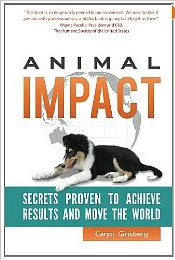
animal-impactI first stumbled into awareness of animal advocacy consultant Caryn Ginsberg’s Animal Impact: Secrets Proven to Achieve Results and Move the World (Priority Ventures Group, Arlington, VA, 2011) on the web site of the Humane Research Council, a treasure trove of animal welfare-related research, statistics, and trend analyses. Within seconds of reading the synopsis, I deemed it a must-read. Not only did the book strike me as directly relevant given my line of work, but its roster of interviewees and endorsers constituted a veritable Who’s Who of heavy hitters from all across the animal welfare field; represented organizations ranged from the ASPCA, the Humane Society of the United States, and PetSmart Charities International to Mercy for Animals and Compassion Over Killing to Spay/USA to the Vegetarian Resource Group, Wildlife SOS, the World Society for the Protection of Animals, and the Humane Research Council itself…to name just a few.
While the book is a worthwhile read for all who are committed to making the world a better place for animals, it is most useful for those on the front lines of advocacy campaigns, communications, and marketing at animal-focused organizations — Ginsberg argues that effective messaging is the cornerstone of organizational success. Her narrative deftly interweaves best-practice tips, real-life case studies, words of wisdom from over 80 animal welfare and animal rights leaders (gleaned from both successful and failed efforts), thoroughly researched statistics, and thought-provoking exercises. All these are presented through the lens of Ginsberg’s signature ACHIEVEchange™ system built on the following tenets:

Action [Should Be Tailored to] Audience
Create Benefits & Cut Barriers
How to Say Something to Someone Instead of Nothing to Everyone
I Am Not My Target Audience
Education Isn’t Enough
Voice Matters
Evaluate, Don’t Guess

A recurring theme throughout the book is a strong emphasis on the importance of people skills to successfully and sustainably change hearts, minds, and deeply ingrained cultural norms and individual habits. This entails meeting people where they are — allowing them to lean into change gradually and draw upon what uniquely drives them — and consistently demonstrating outstanding customer service and high levels of accountability, transparency, and integrity. In short, Ginsberg’s book strives to professionalize what is in many respects still a grassroots movement led by people whose perspective, experiences, and personal motivations tend to be markedly different from those of their target audiences — with the understanding that for many of these leaders, some of their toughest customers may be their own friends and family. The book also underscores the necessity of thoughtful, strategic marketing for maximum effectiveness and impact.

Admirably, Ginsberg refrains from promoting any specific political agenda and presents ideas from leaders whose positions span the gamut along the animal welfare/animal rights spectrum, neither condoning nor condemning any of these positions. Instead, she highlights common threads that illustrate concrete principles for strengthening the success of advocacy efforts.

I had hoped that the book would contain more substantive information about conducting outcome evaluations to assess organizational impact, but this topic was limited to only one chapter that merely scratched its surface. On the other hand, an unexpected boon was the footnotes section referencing the wealth of sources from which the author drew her vast array of relevant statistics scattered throughout — I actually found this one of the most helpful components of the entire book. Thanks to Ginsberg’s well-documented research, I now know which sources to consult in the future for U.S. statistical information such as:

  • Total lab animal population
  • Total number of healthy/adoptable dogs and cats euthanized in shelters annually
  • Total number of animals killed for food and hunted for sport annually
  • Annual dollar value of animals sold by pet stores and breeders
  • Annual dollar value of fur sales
  • Percentage of U.S. adults who follow animal-related news stories daily, weekly, or monthly
  • Proportion of universities with human-animal studies courses or animal law programs, and proportion of medical schools that do not require terminal animal labs
  • Annual per capita consumption of animal products
  • Proportion of states with felony-level animal cruely laws

The book also introduced me to The Social Animal, an online resource geared toward helping animal advocates make the best use of social media. Additionally, the book includes a link to a free downloadable digital companion workbook pre-populated with key points and exercises from each chapter and the functionality to insert one’s own notes as desired, which I found especially helpful.

At one time or another, all of us in the animal welfare field — regardless of our role or level of expertise — are called upon to advocate for our cause. From that perspective, Animal Impact is the ideal tool to help ensure that when that time comes, our words and actions truly advance the best interests of the animals we work so passionately to protect.

10 Steps to Better (Fundraising) Health in 2013

Although January is one of my two least favorite months of the year (the other being February), I always appreciate the opportunity it presents to make a fresh start, both personally and professionally. With this in mind, my most recent ASPCA blog post, which just went live yesterday, offers some tips to foundation fundraising professionals for getting the New Year started off on the right foot.

Santa’s really outdoing himself this year…

Year-End Strategies for Raising Funds, Not Your Blood Pressure

Have the mounting pressures of year-end foundation fundraising got your whiskers in a twist? In my latest post on the ASPCA’s blog, which just went live yesterday, I offer some hard-won advice for staying sane while staying on course, gleaned directly from my years in the fundraising trenches at the Foundation Center.

2013 $100k Challenge: Are You Ready?

ASPCA Rachael Ray 100k ChallengeThanks to the generous support of celebrity TV chef Rachael Ray, the ASPCA will once again hold its $100k Challenge in 2013 for animal shelters around the country to save more lives than ever before. Building on the momentum created by the tremendous success of the 2012 Challenge, the application period for the 2013 Challenge opens on Thursday, January 3, closing Wednesday, January 23 or until a sufficient number of eligible applications is received, whichever comes first. Contestants compete to save more lives from June 1 through August 31, 2013; a total of $600,000 in prize grants ranging from $5,000 to $100,000 will be awarded. Winners will be announced on or before September 30, 2013. Participation benefits reported by past Challengers have included a significant increase in support from their local communities, stronger teamwork, and rekindled inspiration to try new strategies and tactics for saving more lives.

The ASPCA is inviting interested organizations to register for one of two free information sessions on the 2013 Challenge to be held via webinar on Monday, December 10 at 3pm ET or Wednesday, December 12 at 5pm ET. Detailed information about the 2013 Challenge is also available online. Rev up your engines and good luck!

—–

UPDATE AS OF 1/3/13: Applications for the Challenge are now being accepted at http://challenge.aspcapro.org/.

Small Animals, Big Grant