Funding for a Weekend of Community Adoption Events

From a recent ASPCA announcement:

ASPCA Announces Grant Program to Support Third Annual
Mega Match-a-thon

Last year, the second ASPCA Mega Match-a-thon saw more than 5,700 animals adopted in 36 communities around the county. This year the ASPCA is again providing grant funding to support a weekend of high-volume community adoption events to take place simultaneously across the country during October 17-19, 2014.

Grants will be made for up to $10,000 each, and the ASPCA is interested in applications that demonstrate how a significant increase in adoptions will be achieved through collaboration and community involvement.

Applications open from May 1 at 10 am ET to May 15 at 5 pm ET.
You will not be able to access the application link outside this timeframe.

Learn more by reading the RFP online or downloading a PDF file.

Best of luck!

Spring Forward with Conferences & Training Opportunities

Supporting A Second Run for Retired Racehorses

In loving memory…and in search of a cure

Tufo and Missy

Back in May 2011, I announced my joyful adoption of two fabulous new feline family members, Tartufo (“Tufo”) and Tiramisu (“Missy”). This enchanting brother-sister pair found their place in our home and our hearts so quickly that it was hard to imagine life without them. Although they were already 7 years old when they came to us, we looked forward to what we hoped would be at least another decade with them.

This past fall, only two and a half years later, both cats succumbed to cancer — Tufo in October, followed by Missy in December. According to the multiple veterinarians we consulted, there was nothing we could do to send the cancer into remission; we could only try to maintain their quality of life for as long as time allowed.

Given the despair and grief I felt in losing them far too soon, I was compelled to take a closer look at the leading organizations investing significant dollars into sparing other cat owners this kind of heartbreak in the future. I’ve been meaning to write this post for months, and have only just now finally gathered the strength for it after a long, hard winter.

The go-to resource for funding to better understand hereditary diseases in cats is the Cat Health Network (CHN), whose stated goal is “to improve feline health and welfare by funding focused feline health studies.” Research is conducted using samples of feline single nucleotide polymorphisms (SNPs). SNPs represent minor variations from the standard feline DNA sequence that can be used as markers to identify the specific genes involved in genetic diseases. CHN is a collaborative effort on behalf of the following four organizations:


Winn Feline FoundationDedicated to supporting scientific research that focuses specifically on advancing feline health, the Wyckoff, NJ-based Winn Feline Foundation offers funding for researchers as well as a comprehensive online cat health library (which includes an article on feline cancer) and a cat health blog. A list of Winn’s annual research grant awardees is available on its web site. In partnership with Zoetis, the foundation is currently inviting grant proposals for research projects addressing the assessment of pain, osteoarthritis, joint health, and kidney disease in cats until Monday, April 21, 2014

Morris Animal FoundationThe Morris Animal Foundation in Denver, CO funds scientific projects that advance veterinary medicine for companion animals, horses, and wildlife. A major beneficiary of this funding is cats: since 1950, the foundation has invested more than $9.5 million in over 300 feline health studies. The foundation’s web site describes some of the veterinary advances for cats made possible by its funding, as well as foundation-supported feline health studies currently underway (including feline cancer studies).


AAFPThe Hillsborough, NJ-based American Association of Feline Practitioners (AAFP), originally an offshoot of the American Veterinary Medical Association (AVMA). is committed to advancing feline medicine and surgery by setting and supporting high standards of practice for feline care via the publication of practice guidelines and position statements, and by providing its members with continuing education. A list of AAFP’s annual research grant awardees is available on its web site.


AVMFThe American Veterinary Medical Foundation, the AVMA’s philanthropic arm in Schaumburg, IL, provides funding for a variety of endeavors, including animal health studies that explore the causes, prevention, and treatment of fatal and infectious diseases via innovative medical advancements. The Foundation’s Animal Health Studies grant application is available online.


It’s also worth highlighting the Veterinary Cancer Society in Columbia, MO, a global association for veterinary oncology professionals. Although not involved in direct funding for research, it still has an important role to play in promoting breakthroughs in animal cancer treatment. From its web site:

While the focus of our organization is not in funding research directly, we strongly encourage research and collaboration among our members. Each fall, the Veterinary Cancer Society holds an annual conference, one of the largest veterinary oncology meetings in the world. This conference brings together the brightest veterinary oncology specialists who often participate in research as well as treat animals in their private or academic practice every day. These people share with the attendees new information obtained through research in the ongoing fight against cancer. Typically, new collaborations for research are formed among members during our breaks and in our specialist meetings, and from those collaborations come some outstanding research projects [from which] cutting-edge treatment options can be generated.


The war against cancer in both humans and animals alike is being waged on many fronts. Though the road ahead is long, the above-mentioned organizations give me hope that someday, people will no longer lose loved ones of any species to this devastating disease.


July 10, 2014 update:

A recent Tufts study just hit the news yesterday underscoring secondhand smoke as a major contributing factor to cancer in both cats and dogs. According to the study, cats are especially susceptible to tobacco smoke — repeated exposure to smoke doubled a cat’s chances of getting cancer (lymphoma in particular) and living with a smoker for more than five years increased the risk fourfold.

Tufo and Missy lived with their previous owner for seven years before finding their way to us; I now suspect that person may have been a smoker. Although I’ll of course never know exactly why both of them developed cancer relatively young and so close to the same time, this seems like a very plausible explanation.

The moral of the story is: don’t let anyone smoke around your pets!

A funding lifeline for critically endangered amphibians

Raising Funds and Awareness with Ready, Set, Rescue

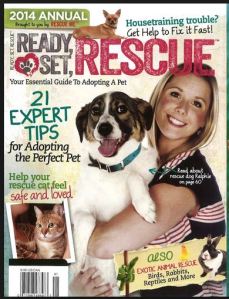
Ready, Set, RescueA few weeks ago, as I was standing in the grocery checkout line preparing to pay for my purchases and breezing past the usual hodgepodge of tabloids and entertainment magazine mainstays, a dog’s face suddenly leapt out at me from among the covers.

What was this? Certainly not what you’d call a celebrity rag!

I picked up the intriguing volume of Ready, Set, Rescue, printed on solid, full-color magazine stock, to examine it. Designed to serve new and prospective adopters of homeless pets, it was packed with useful tips to ease the transition for all concerned. I felt somewhat embarrassed that I work in animal welfare yet had no idea that this publication existed, but thrilled that it had found its way to a venue as heavily trafficked as my local supermarket. What brilliant marketing for the cause of animal rescue!

Once I got home and had a chance to read it more closely, I saw that it had some “star power” of its own — the magazine’s board of advisors includes one of the founders and directors of the nationally renowned Best Friends Animal Society; “cat whisperer” Jackson Galaxy made famous on the Animal Planet show, “My Cat from Hell”; and the executive director of Found Animals Foundation, whose $75 million Michelson Prize & Grants program funds cutting-edge research that advances the development of a permanent, single-dose, non-surgical sterilant for male and female cats and dogs.

The magazine’s content is a treasure trove of easy-to-digest nuggets of wisdom for soon-to-be and new pet parents, featuring articles on topics ranging from key factors to consider when adopting a pet to behavioral training strategies for the pet’s harmonious integration within a new household to health checklists for dogs and cats to essential supplies for meeting new pets’ needs to directories of additional resources for new pet owners. And the information goes beyond dogs and cats to provide starting points for those considering the adoption of companions such as reptiles, birds, rodents, equines, and farm animals.

In addition to equipping adopters with guidance to facilitate the best possible adoption outcomes, the magazine is also geared toward helping individual shelter and rescue organizations raise funds for their efforts. Organizations that purchase bulk “Go-Paks” of Ready, Set, Rescue issues bundled together with the bimonthly magazine Rescue Me showcasing “happy tails” of adoption successes around the nation — available at a deep discount — subsequently sell them to adopters/adopters-to-be at full retail value, making approximately a 70% profit. Furthermore, organizations that register online for a special ID number become eligible to receive about two-thirds of the price of each subscription to Rescue Me whenever their organization is designated as a recipient by the subscriber.

So what this innovative approach essentially amounts to is a win-win-win-win situation for no less than four parties: adopters (who become better informed about their new family members), shelters and rescues (which receive earnings from magazine sales, and whose cause is widely promoted and positioned for success), the publisher (which accomplishes its mission of helping homeless animals while earning revenue), and especially the animals (who have a better chance of finding — and staying in — new homes).

That said, the magazine’s ability to make a substantial difference for all these various stakeholders is heavily dependent on sales volume…so if the concept appeals to you, here’s how to get involved. Good luck and enjoy!

Takeaways from the AWFNJ 2014 Conference

This past weekend, I had the privilege of attending the annual conference of the Animal Welfare Federation of New Jersey, where I met lots of great people and picked up some helpful pointers. Although valuable information was shared in almost every session, I’ve compiled specific live-tweet tips below from the two sessions most relevant to folks who are starting and seeking funds for their shelter or rescue.

Creating a Successful Animal Rescue” offered the following advice:

  • Define the animal type(s) you’ll rescue, carve out a niche, & establish your brand.
  • Identify your sources for rescued animals & make sound plans for transporting them.
  • Start small w/ what’s manageable & build up gradually…it’s better for the animals!
  • Develop a good foster network and create clear processes & helpful resources for foster families.
  • Build up an emergency fund, particularly for unexpected veterinary expenses.
  • Make sure everyone involved has the training they need to best serve the animals.
  • Hold a formal volunteer orientation & regular volunteer meetings.
  • Compile e-mail & phone lists for emergency communications among volunteers & staff.
  • Don’t reinvent the wheel; seek advice from other rescues about successes/challenges.
  • Incorporate as a 501c3 org; increases funding opportunities & shows accountability.
  • Be sure to obtain liability insurance and a raffle license.
  • Be visible in your community w/adoption events, tables @ fairs/festivals, & parades.
  • Network with a variety of others as much as possible to ensure your sustainability.
  • Good marketing is key, esp via social media; it’s free & can be done by volunteers.
  • Marketing materials should include a brochure, T-shirts, and a mailing/e-mail list.
  • Build a web site & make sure it’s clean & easy to navigate to showcase your animals.
  • Establish relationships w/local media (newspaper, radio, TV) & local businesses.
  • Share your happy stories…people are hungry for them.

A One-Man Band Guide to Fundraising,” which was presented by Erika Mathews, VP of Development at St. Hubert’s Animal Welfare Center (one of my personal favorites), imparted the following words of wisdom:

  • Asking for $ is easier when you remember you’re asking for the animals, not for yourself.
  • When seeking grant support, following instructions is critical & will serve you well.
  • For direct mail, create a donor file & gather your best photos.
  • Mailing list rentals from similar organizations can be worthwhile & fairly inexpensive.
  • Filing for discounted mailing rate via USPS (Nonprofit Indicia) isn’t hard & adds up to significant savings,
  • The holiday season is the best time to send mass mailings.
  • Including a QR code that makes it easy to donate online appeals to younger donors.
  • Info re planned giving can be provided subtly w/a checkbox option in mailings & online.
  • Give people options for making a memorial donation in honor of a special person or pet.
  • Printed newsletters sent in envelopes raise much more $ than those mailed without them.
  • E-blasts (newsletters/appeals) sent with tools like ConstantContact are very cost-effective.
  • Post wish lists of needed items on your web site, in print at your shelter, & on Amazon.
  • Be sure your web site makes it very obvious where/how to donate to your organization.
  • Crowdfunding web sites such as Kickstarter & LoveAnimals can bring in additional funds.
  • Partner up w/local businesses for direct donations & for raffle/tricky-tray donations.
  • Sites like CafePress & Zazzle allow you to create personalized merchandise for your org.
  • Register for AmazonSmile, which gives your org a percentage of shoppers’ purchases.
  • Be very selective about the events you hold: should raise significant $ and awareness.
  • Make sure to keep your donors’ data & giving history clean & current.
  • It’s helpful to keep donor info organized in a database (DonorPerfect is user-friendly).
  • When someone makes a gift, send a timely acknowledgement letter/thank-you note.
  • Keeping in touch w/donors about your work & making personal contact goes a long way.
  • Take time to assess which of & how well your different fundraising strategies are working.

My next stop on the conference circuit: Animal Care Expo in Daytona Beach, FL May 20-23, where I’ll be co-presenting the session, “Ingredients for a Successful Grant Application.” Will you be there?

Got Special-Needs Cats?

New Spay/Neuter Grant Opportunities

PetSmart Charities is now accepting applications from organizations in the United States and Canada for its 2014 High-Impact Spay/Neuter Grants. Specific opportunities include grants for targeted spay/neuter, free-roaming cats, spay/neuter clinic equipment, and spay/neuter “blitz” promotional campaigns.  Eligible applicants include registered charities, government agencies, and tribal authorities in the U.S. and Canada. Applications are being accepted on a rolling basis.  See the program guidelines for further information.

In honor of Word Spay Day‘s 20th anniversary and the recent launch of Zeuterin™, the only non-surgical sterilant for dogs approved by the FDA, the Alliance for Contraception in Cats and Dogs (ACC&D) — in partnership with Best Friends Animal Society, the Humane Society of the United States (HSUS), and the Kenneth A. Scott Charitable Trust — is holding a contest for U.S. municipal agencies, 501(c)(3) animal shelters and rescues, veterinary practices, and spay/neuter programs to win grants of up to $2,000 for their spay/neuter programs. Contestants are invited to share the best strategies that their organizations have implemented for marketing Zeuterin or incorporating it into their spay/neuter operations, and to describe the impact those strategies have had. Zeuterin’s potential advantages over traditional spay/neuter methods include reducing neutering costs, reaching communities without surgical facilities, sterilizing male dogs whose owners resist surgery, and neutering dogs who cannot safely undergo anesthesia. Submissions must be received by September 1, 2014.  See the contest guidelines for more information.

Is Your Organization Ready for a Campaign?